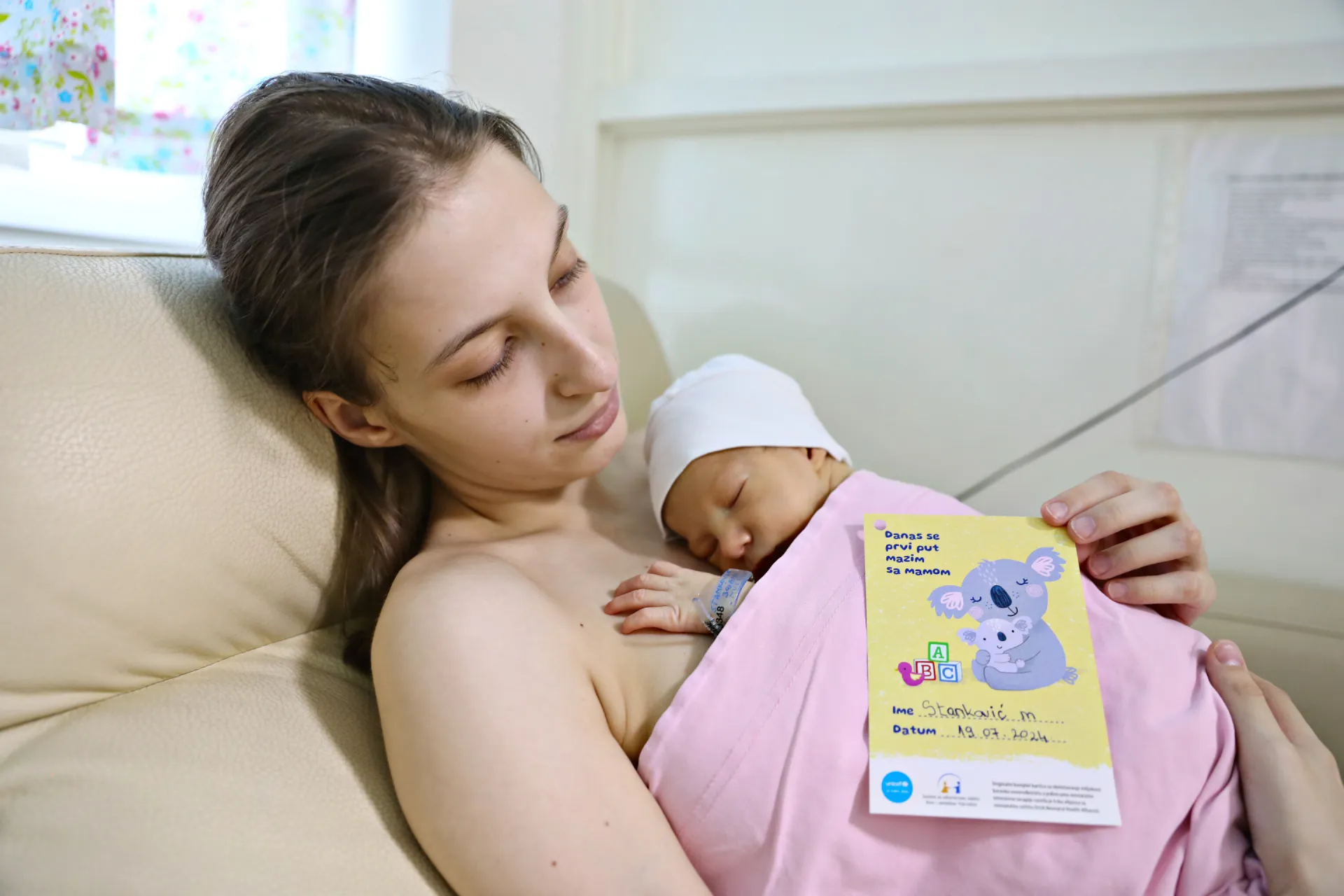
Of approximately 62,000 babies born every year in Serbia, around 4,000 are born prematurely. This means that ten babies are born before term every day, and seven of them require intensive neonatal care in order to have a chance for healthy development. Premature birth is a challenge not only for the babies but also for their parents, having to deal with uncertainty and fear. That is why it is important to provide them with appropriate support, both within the healthcare system and in the community. UNICEF is working to ensure that every premature baby receives the best possible care and a chance for a happy and healthy life.
Factors leading to premature birth
Premature birth (delivery before the 37th week of pregnancy) can be caused by various factors:
- The mother’s health – chronic conditions such as hypertension, diabetes or infections;
- Multiple pregnancy – twins, triplets or other multiple pregnancies are more likely to case preterm birth;
- Problems with the uterus or cervix – structural abnormalities can make it difficult to maintain pregnancy to full term;
- Adverse socioeconomic conditions – lack of prenatal care, poor nutrition and stress increase the risk of premature birth.
Why is the struggle of premature babies so difficult?
A prematurely born baby continues to develop outside the womb, in an environment for which its body is not yet fully prepared. Medical assistance is crucial, but emotional security, bonding with mom and dad and psychological support for the family are equally important.
Consequences of premature birth
Premature babies face numerous health challenges because their organs are not yet fully developed.
Breathing, weight and organ problems
Babies born prematurely often have breathing difficulties due to underdeveloped lungs, which may require additional respiratory support. Their body weight is lower, and their immune system is underdeveloped, making them more susceptible to infections.
Impact on neurological and cognitive development
The brains of premature babies are not fully developed, which can lead to difficulties in learning, speech and motor skills. Early stimulation treatment and professional support can significantly improve their development.
Long-term challenges of premature birth
Some preterm children may experience long-term health problems, such as vision and hearing impairments, chronic respiratory conditions, and an increased risk of metabolic disorders later in life.
“Skin-to-skin”: a parent’s touch means precious support for the baby
Research shows that “skin-to-skin” contact reduces the risk of mortality in premature and low birth weight babies by up to 40%. The reason is simple: the baby feels the warmth, smell and heartbeat of the parent, which helps stabilize its breathing, heart rate and body temperature.
“Skin-to-skin contact reduces stress, as babies can listen to their mom’s heartbeat and voice, and feel the warmth and smell of their mom’s body. At the same time, lactation is stimulated, which is so important for a child's natural nutrition”, neonatologist Dr Radmila Mileusnić Milenović explains.
That seemingly brief moment makes a tremendous difference in calming the baby, weight gain and strengthening the family bond from the very beginning.
How incubators help premature babies
Incubators play a crucial role in the care of premature babies by providing a stable and controlled environment that enables:
- temperature regulation – premature babies struggle to maintain body temperature, and incubators ensure thermal stability;
- protection against infections – the sterile environment of the incubator reduces the risk of infections to which premature babies are particularly susceptible;
- monitoring of vital functions – medical devices in incubators monitor breathing, heart rate, and oxygen levels, allowing physicians to respond quickly;
- support for growth and development – incubators help babies grow and develop in conditions that simulate the womb.
Meet the children and families we’ve helped
Elena – a little girl born two months early
Baby Elena was born at 29 weeks, weighing only 980 grams. Her mother Mirjana recalls:
“When Elena was born, she weighed just 980 grams and we were very concerned about her development. It’s much more stressful when you cannot be with your baby.”
For over 30 days, Mirjana could only see Elena through the glass of the incubator. Everything changed when UNICEF donated chairs for “skin-to-skin” contact and additional equipment to the Kragujevac Neonatology Centre. When Elena finally rested on Mirjana’s chest, a miraculous turning point occurred:
The moment I took her in my arms, the magic began... At that moment time stopped and it was just the two of us... Already the next day, her weight increased significantly.”
Dr Dragana Ristić, Head of the Centre, explains why skin-to-skin contact between a baby and a parent is so important:
“Skin-to-skin contact reduces stress, as babies can listen to their mom’s heartbeat and voice, and feel the warmth and smell of their mom’s body. At the same time, lactation is stimulated, which is so important for a child's natural nutrition”.
Lenka and Miona – prematurely born twins from Novi Sad
Identical twins Lenka and Miona were born two months early at the Institute for Child and Youth Health Care of Vojvodina. Their mom Milana describes what it’s like to stay in the neonatology ward:
“I come down every 3 hours, and each time we have skin-to-skin contact. At first, we made contact through the incubator openings, but as the girls became more stable, we were able to cuddle for longer periods.”
Their father, Dragan, never misses on opportunity to visit them twice a day and says the girls calm down as soon as they feel his touch. The ward practices developmental and family-oriented care, with reduced noise and dimmed lights to support the babies’ psychomotor development.
“I make sure to come both in the morning and in the afternoon to see them and make sure they’re OK. I take every opportunity to touch the babies. It means so much to me, and I believe it means a lot to them, too. Often, when they’re agitated, they calm down when either my wife or I hold them.”
Dr Slobodan Spasojević says this approach wasn’t always standard:
“Only in recent years... have fathers also participated in “skin-to-skin” contact. Babies calm down more quickly this way, and parents feel a deeper bond with their child.”
Why your support matters
Thanks to donations, UNICEF provides skin-to-skin contact chairs, nests, refrigerators for milk banks and other essential equipment, as well as additional training for doctors and nurses. This not only ensures a stable and safe environment for the survival and development of premature babies, but also offers them precious closeness with their parents, which is crucial for their progress and emotional bonding.
How you can help
Supporting premature babies and their families can significantly improve their quality of life. Your donation helps provide hospital equipment:
- RSD 2,200,000 – one neonatal resuscitation table,
- RSD 2,030,000 – one incubator,
- RSD 48,000 RSD – one “skin-to-skin” chair.
Together we can do more. With your support, we can provide life-saving equipment and create a brighter future for our tiniest fighters.